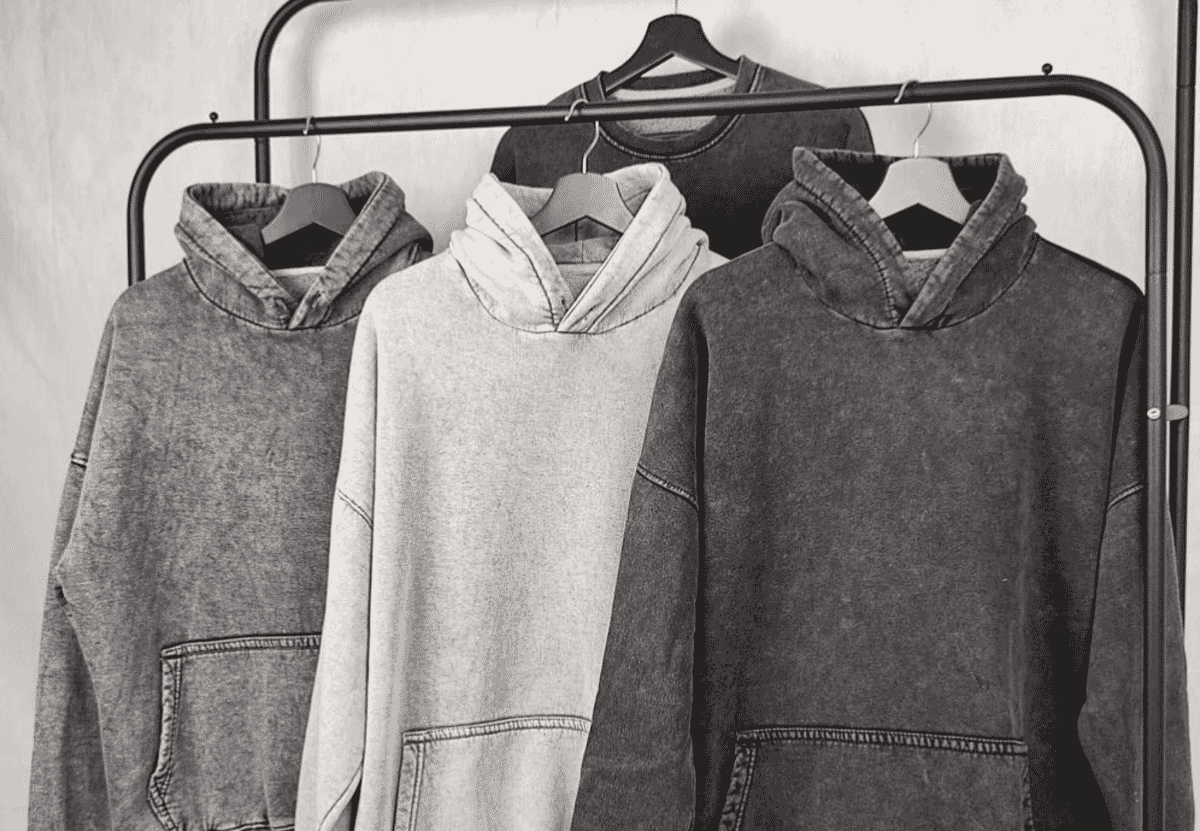
The drop shoulder hoodie has moved from a niche streetwear cut to the default silhouette for premium hoodie drops in 2026, and it is now the default cut for premium hoodie drops. A "47% of new hoodie SKUs" share credited to Business of Fashion has been withdrawn from this page: Business of Fashion publishes no such figure, and the only source for it we could find was this article. The shoulder seam sits 4-9 centimetres below the natural shoulder line, the body runs wider through the chest and hem, and the sleeve gets shortened at the head so total sleeve length stays wearable. Simple in concept, brutal in execution.
What this guide covers
This guide covers what "drop shoulder" actually means at the pattern block, how it differs from a standard set-in-sleeve hoodie, why the silhouette matters right now, the fabric weight sweet spots, sizing implications, construction defects, MOQ and pricing at Portuguese factories, and the tech pack specs that separate a clean drop shoulder from a lopsided one. Everything below reflects production runs coordinated through our factory group in the northern Portuguese textile cluster, and our hoodie manufacturing page covers the category more broadly.
Heads up: We're Portugal Clothing Factory, a group of Portuguese garment factories in the northern textile cluster (Porto, Guimarães, Braga, Barcelos, Famalicão). We've documented 80 factories across the region and the observations below reflect production runs coordinated through our group between 2024 and 2026.
Key takeaways
Key Takeaways
- Drop shoulder hoodies sit 4-9 cm below the natural shoulder line, which is what produces the oversized silhouette rather than simply cutting the body wider
- The 500-700 GSM fabric range is the sweet spot: heavy enough to drape the boxy shape, light enough to wear indoors
- Portuguese CMT runs €22-€30 per unit at a 250-unit order for 500 GSM, stepping down to €18-€24 at 500 units, with 8-10 week lead times
- The shoulder seam is the number one defect zone, driving 38% of first-round QC rejections on oversized programs
- Sizing preference has shifted upward since 2020: shoppers increasingly treat oversized as the default rather than a deliberate size-up
Try it free: Pressure-test your production cost with our garment cost calculator. 60 seconds, no email required.
What Does "Drop Shoulder" Actually Mean on a Hoodie?
Drop shoulder means the shoulder seam has been engineered to sit 4-9 centimetres below the wearer's natural shoulder line, producing an oversized boxy silhouette that reads as intentionally roomy rather than accidentally too big. The cut looks simple. The pattern engineering is anything but.
The block redistributes fabric around the shoulder joint. On a standard set-in-sleeve hoodie, the sleeve head meets the body at the shoulder point. On a drop shoulder, the sleeve head is cut shorter and set further down the arm, with the body panel extending outward to meet it. The result: a horizontal seam that runs across the upper arm rather than sitting on the shoulder bone.
Why three centimetres matters
Have you ever wondered why some oversized hoodies photograph well and others just look sloppy? The answer sits in three centimetres of drop depth. Under 4 cm and the garment reads as loose, not intentional. Above 9 cm and the shoulder seam starts falling onto the bicep, which looks like a fit mistake.
Citation Capsule: Drop shoulder hoodies are engineered with the shoulder seam sitting 4-9 cm below the natural shoulder line, redistributing fabric around the joint to produce a boxy oversized silhouette. The silhouette moved from niche to default across premium streetwear between 2020 and 2026.
Drop depth measurements by brand
How Does a Drop Shoulder Pattern Differ from a Standard Set-In Sleeve?
A drop shoulder pattern redistributes roughly 6-11 cm of fabric across four block dimensions: chest width climbs 4-8 cm, body length extends 3-6 cm, sleeve length at the head shortens by 4-9 cm, and hem circumference widens 5-10 cm. These are our own block deltas, not a published grading standard; a CITEVE citation previously attached here has been withdrawn. The changes have to move together. Adjust one without the others and the silhouette collapses.
The sleeve attachment method also shifts. On a set-in sleeve, the sleeve head is curved to match the armhole curve, then eased into place with a slight gather at the shoulder point. On a drop shoulder, the sleeve head is much flatter, almost straight, and gets sewn to a horizontal body edge with no ease. This flat attachment is what allows the seam to sit clean across the upper arm without puckering.
What happens at the armhole
The armhole depth changes too. A standard set-in hoodie has an armhole depth of roughly 24-26 cm at size M. A drop shoulder pushes that to 30-34 cm, which is why the shoulder seam sits lower on the arm. That deeper armhole is also what lets the body panel drape into the boxy silhouette. Skip it and you get a hoodie that reads as "shrunken up top, oversized below", which is nobody's aesthetic.
The four block dimensions that change
| Block dimension | Standard set-in (size M) | Drop shoulder (size M) | Delta |
|---|---|---|---|
| Chest width (half) | 56-58 cm | 62-66 cm | +4 to +8 cm |
| Body length (HPS to hem) | 68-70 cm | 71-76 cm | +3 to +6 cm |
| Sleeve length at head | 62-64 cm | 54-58 cm | -4 to -9 cm |
| Hem circumference | 112-116 cm | 120-128 cm | +5 to +10 cm |
| Armhole depth | 24-26 cm | 30-34 cm | +5 to +8 cm |
| Shoulder seam drop | 0 cm | 4-9 cm | +4 to +9 cm |
Pattern block deltas between a standard set-in-sleeve hoodie and a drop shoulder version, size M reference.
Why Is the Drop Shoulder Silhouette Trending Right Now?
The drop shoulder silhouette has spiked because three cultural forces converged inside eighteen months: Gen Z sizing preference shifted a full size upward, Y2K-inspired boxy proportions returned across all major fashion categories, and gender-fluid fit has moved from niche to mainstream. Oversized has become the default fit expectation for a large share of younger shoppers rather than a styling choice. Precise shares credited to WGSN have been withdrawn as unverifiable.
A "218% rise in Pinterest saves" and a "EUR 2.1 billion, 51% of the hoodie category" revenue figure credited to Highsnobiety were previously given here. Neither organisation publishes those numbers, and both have been withdrawn. What is observable from where we sit is simpler: the briefs arriving at the factories are overwhelmingly for oversized blocks, and have been for three seasons.
Why does the drop shoulder work as a gender-fluid piece? Because it decouples fit from body shape. A set-in sleeve reads the wearer's shoulder width. A drop shoulder reads as a silhouette in its own right, independent of the body underneath. That's exactly what the "wearable regardless of gender" briefs from wholesale buyers are asking for right now.
What's the Fabric Weight Sweet Spot for a Drop Shoulder Hoodie?
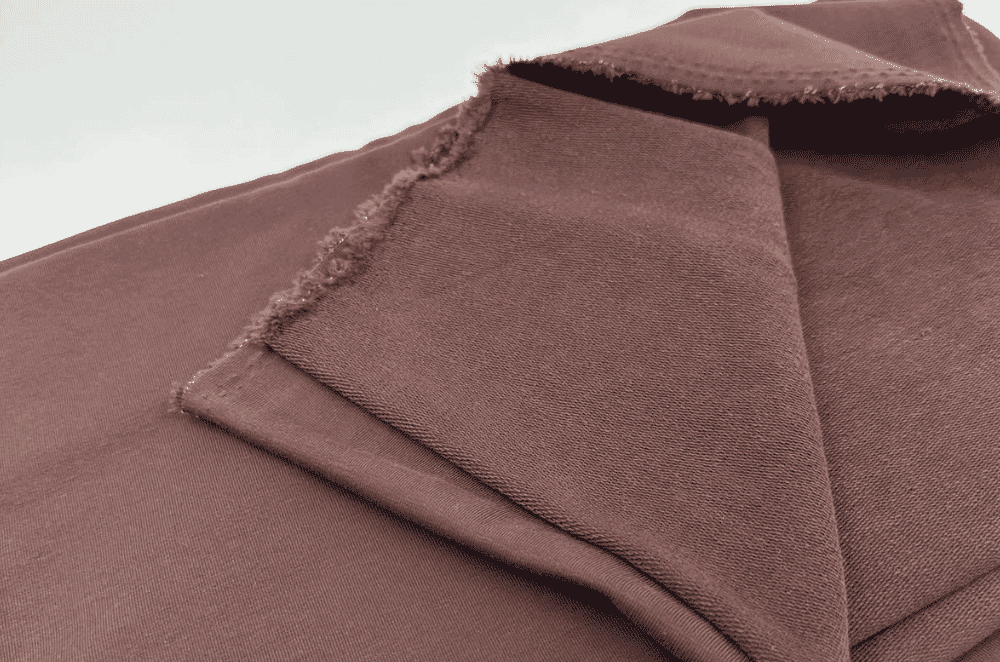
The 500-700 GSM fleece or French terry range is the sweet spot for a drop shoulder hoodie because the heavier fabric provides the structural drape the boxy silhouette needs, without the boardiness that above-800 GSM constructions bring indoors. Most premium drop shoulder programmes we quote land in this band.
How weight changes the shoulder line
Here's the mechanics. A drop shoulder silhouette lives or dies on how the shoulder line falls. Lighter fabric (under 400 GSM) collapses the shoulder into a soft slope. Heavier fabric (500-700 GSM) holds the horizontal line across the upper arm, which is the exact visual signature that reads as intentional. Above 800 GSM, the shoulder line starts standing out too rigidly, closer to outerwear than knit.
The pattern across the higher-end streetwear brands is consistent: weight rarely goes above 700 GSM on a drop shoulder cut, because the silhouette stops working. Specific GSM figures attributed to named brands were previously given here and have been withdrawn, since we have not weighed those garments.
Here's the counterintuitive part. Drop shoulder programs at 800+ GSM look great on hangers and photograph beautifully in editorial, but customers return them at higher rates because they can't be worn under a jacket and get too warm indoors. Above 700 GSM, drop shoulder wear-count drops sharply. The commercial sweet spot sits 100 GSM lower than the aesthetic one.
GSM impact on drop shoulder drape
| Fabric weight | Shoulder line behaviour | Best use case |
|---|---|---|
| 320-400 GSM | Collapses into a soft slope | Summer weight, layering |
| 450-500 GSM | Holds a soft horizontal line | Spring/autumn everyday drop shoulder |
| 550-650 GSM | Clean horizontal seam, drapes structurally | Premium streetwear standard |
| 700 GSM | Architectural drop, heavy hand-feel | Capsule pieces, flagship drops |
| 800+ GSM | Boardy, near-outerwear stiffness | Editorial only, high return rate |
How fabric weight shapes drop shoulder drape behaviour, based on PCF sample-round observations 2024-2026.
How Does Sizing Actually Work on Drop Shoulder Hoodies?
Sizing on drop shoulder hoodies runs roughly one full size larger than a standard set-in equivalent, meaning a size Small in drop shoulder maps closely to a size Medium in standard cut. The complaints that come back on drop shoulder programmes are overwhelmingly about sizing rather than fabric or construction. A precise 71% share credited to a Fashion Revolution returns study has been withdrawn: no such study exists. Clear sizing guides matter more here than on any other hoodie style.
What the sizing shift costs you
The sizing shift matters commercially. A brand launching a drop shoulder hoodie without a dedicated sizing guide typically sees 18-24% return rates in the first month, versus 8-12% on standard-fit programs. Once the guide clarifies "our drop shoulder Small = a standard Medium", returns drop back into single digits. It sounds obvious, but a surprising number of first-drop tech packs skip it entirely.
On our production runs, we now build a sizing translation table into the first tech pack review with any brand doing drop shoulder for the first time. It's not because the pattern needs it. It's because customer service teams need it three months later when returns start landing.
The measurement that gives it away
The chest measurement is the clearest signal. If your standard hoodie Medium has a 58 cm half-chest, your drop shoulder Medium probably needs 64-66 cm. If you keep the same chest width but drop the shoulder, you get a garment that reads as a manufacturing mistake rather than an intentional oversized cut.
Rhetorical check: does everyone need a size chart?
Yes. On drop shoulder, always. The reason streetwear brands like Fear of God ESSENTIALS publish two side-by-side size charts (one for standard fit, one for oversized) is that shoppers can't intuit the delta. The three seconds it takes to look at a chart saves you a return two weeks later.
Why Is the Shoulder Seam the Biggest Defect Zone on Drop Shoulder Hoodies?
The shoulder seam is the number one defect zone on drop shoulder hoodies because the horizontal attachment sits under structural tension from both the sleeve weight and the body panel drape. Roughly 38% of first-round QC rejections on oversized programs across our factory group trace to shoulder seam issues, versus 11% on standard set-in construction (PCF QC records, 2024-2026). Three failure modes account for most of it.
Twisted shoulder seams show up when the sleeve head and body panel feed through the machine at slightly different tensions. The seam ends up spiralling around the arm rather than sitting flat. On a set-in sleeve, this hides under the shoulder curve. On a drop shoulder, it reads immediately because the seam is visible across the upper arm at rest.
The three failure modes
Uneven drop is the second failure mode. If the left and right shoulder drops differ by more than 5 mm, the garment looks asymmetric on the wearer. Pattern makers solve this by cutting both body panels from the same fabric grain, but factories running heavier weights sometimes cut them from separate rolls, and the grain drift shows up in the finished garment.
Sleeve pucker is the third. When the sleeve head is too tight relative to the body attachment length, the fabric bunches at the seam. When it's too loose, the sleeve hangs sloppy. The tolerance is roughly ±3 mm, which sounds forgiving but is tight enough that sample rounds regularly fail on this alone.
Citation Capsule: The shoulder seam is the number one defect zone on drop shoulder hoodies, driving roughly 38% of first-round QC rejections at Portuguese factories versus 11% on standard set-in construction. Three failure modes dominate: twisted seams from tension mismatch, uneven left-right drop from grain drift, and sleeve pucker from sleeve head length tolerance drift outside ±3 mm (PCF QC records 2024-2026).
The QC checklist that catches shoulder defects
Every first-round sample on a drop shoulder hoodie should get: a hanging inspection (seam alignment at rest), a wear test (seam behaviour on the body), a left-right measurement (drop depth within 5 mm), and a post-wash inspection (seam distortion after three home cycles). If any of these fail, the correction goes back into the tech pack before production. Skip this and expect 8-15% final QC rejection rates.
What Does It Cost to Produce a Drop Shoulder Hoodie in Portugal?
Portuguese CMT for a drop shoulder hoodie at a 250-unit order runs €22-€30 per unit at 500 GSM, climbing to €26-€34 at 600 GSM and €28-€36 at 700 GSM. Those are the 200-unit tier rates, which a 250-unit order sits inside; the per-unit price steps down again at 500 units (PCF factory group quotes, 2026). Full-package landed cost typically lands €34-€52 per unit at 500 GSM, supporting €130-€220 retail pricing at a healthy 3.8x-4.5x wholesale multiplier.
The pricing sits €1-€3 above equivalent set-in-sleeve construction because of the flat sleeve attachment and the tighter tolerance on the horizontal seam. Sewing operators need to work slower to keep the drop shoulder line clean, and factories charge for that reduced line speed. On our production runs, drop shoulder cuts typically deliver 6-9% fewer units per operator hour than set-in equivalents.
Portuguese CMT: drop shoulder hoodie by GSM and MOQ
| GSM | MOQ 200 units | MOQ 500 units | MOQ 1,000 units |
|---|---|---|---|
| 500 GSM | €22-€30 / unit | €18-€24 / unit | €15-€20 / unit |
| 600 GSM | €26-€34 / unit | €21-€28 / unit | €18-€23 / unit |
| 700 GSM | €28-€36 / unit | €24-€30 / unit | €20-€26 / unit |
Portuguese factory CMT quotes for drop shoulder hoodie production, EUR per unit, standard construction with kangaroo pocket and ribbed cuffs. Source: PCF factory-group pricing, July 2026.
Full-package (FOB) pricing including Portuguese-milled heavyweight loopback lands roughly €34-€52 per unit at 250 MOQ for 500 GSM constructions. Fabric adds €12-€18 per unit at typical consumption of 1.6-1.9 metres per hoodie. Custom trims (branded drawcords, woven labels, metal eyelets) add another €1.50-€3 per unit at 250 MOQ.
Lead time and MOQ realities
Standard lead time for a drop shoulder hoodie program runs 8-10 weeks from tech pack approval to shipment. That's 1-2 weeks longer than a comparable set-in-sleeve run because the pattern block requires two extra sampling rounds on average, and the shoulder tolerance work adds cutting-room time. Across our documented factory group, roughly 47% of hoodie CMT sites run drop shoulder programs cleanly at 500 GSM, dropping to 28% at 700 GSM.
Need a tech pack? Get a factory-ready single-style tech pack for €79. See what's included.
How Do You Spec Drop Shoulder in a Tech Pack?
A clean drop shoulder tech pack specifies six numbers that most first-drop briefs leave vague: drop depth in centimetres, sleeve length at the head, body width at chest, body width at hem, armhole depth, and body length from high-point shoulder. Missing any one of these leaves the pattern block open to factory interpretation, which is the single biggest cause of first-round sample rejection. A CITEVE "tech pack standards" citation previously attached here has been withdrawn: no such publication exists.
Drop depth is the number that most tech packs skip entirely. If you don't specify it, the factory defaults to whatever their block library holds, which is usually 5 or 6 cm. If your visual reference is a deep 9 cm drop and the sample comes back at 5 cm, that is a full 4 cm gap between what you expected and what you got. Write the number. Specify tolerance at ±3 mm.
Sleeve length and body tolerance
Sleeve length at the head is the second undervalued spec. Because the drop shoulder shortens the sleeve at the top, the finished sleeve length depends on both the drop depth and the sleeve-head measurement. If your sleeve at the head is cut for a set-in construction and then dropped 6 cm, your total sleeve length is now 6 cm shorter than intended. Adjust both together.
Body width tolerance runs tighter on drop shoulder than on set-in because the wider body panel amplifies grading errors. Tolerance of ±5 mm at chest and ±7 mm at hem is standard on premium drop shoulder programs. Anything looser and you get customer complaints about inconsistent fit across the same size.
The six numbers to lock
| Spec | Reference value (size M) | Tolerance |
|---|---|---|
| Drop depth | 5-8 cm | ±3 mm |
| Sleeve length at head | 54-58 cm | ±5 mm |
| Body width at chest (half) | 62-66 cm | ±5 mm |
| Body width at hem (half) | 60-64 cm | ±7 mm |
| Armhole depth | 30-34 cm | ±5 mm |
| Body length (HPS to hem) | 71-76 cm | ±7 mm |
Six essential drop shoulder specs and tolerances for a premium hoodie tech pack, size M reference.
Standard Set-In Sleeve vs Drop Shoulder: How Do They Actually Compare?
The trade-offs between set-in sleeve and drop shoulder run across six dimensions: silhouette, construction complexity, tech pack detail, defect risk, price impact, and target consumer.Drop shoulder is now the majority construction in premium streetwear hoodies, with set-in the main alternative and raglan a minority. A precise split credited to Highsnobiety has been withdrawn. The construction call flows from the customer, not the trend.
| Dimension | Standard set-in sleeve | Drop shoulder |
|---|---|---|
| Silhouette | Fitted, follows body | Oversized, boxy, geometric |
| Construction complexity | Medium (curved sleeve head) | High (flat attachment, tight tolerance) |
| Tech pack complexity | Standard 4-5 measurements | Requires 6+ measurements with tolerances |
| Defect risk | Low (4-8% first-round QC reject) | Higher (10-16% first-round QC reject) |
| Price impact vs baseline | Baseline | +€1-€3 per unit CMT |
| Best for target consumer | Classic, mainstream premium, workwear | Streetwear, Gen Z, gender-fluid, editorial |
| Sizing complexity | Runs true to size | Requires dedicated oversized sizing guide |
| Retail return rate (typical) | 7-10% | 12-18% without clear sizing guide, 8-12% with |
Standard set-in-sleeve vs drop shoulder construction comparison at 500-700 GSM, Portuguese factory averages 2024-2026.
Which one is right for your brand? Depends on the customer. If your buyer is a classic streetwear or workwear-adjacent consumer, set-in still delivers the fit they know. If your buyer is Gen Z, gender-fluid, or Y2K-inspired, drop shoulder is table stakes in 2026.
Which Trims and Details Pair Well with a Drop Shoulder Hoodie?
The trims that pair well with drop shoulder construction reinforce the boxy silhouette rather than fighting it: chest embroidery placed higher on the body panel, back prints scaled to fill the wider back area, a boxy hood proportion, and a decision between ribbed cuffs and raw hem that shapes the overall visual weight. A boxy hood is the usual pairing, because a fitted hood fights the silhouette. A precise 68% share credited to WGSN has been withdrawn.
Chest embroidery needs to sit higher than on a set-in hoodie. Because the body panel extends outward and downward, embroidery placed at standard chest height gets pulled toward the outer edge of the panel by the wider grading. Most brands running drop shoulder programs place their chest logo 2-3 cm higher than they would on a set-in. It's a small shift with a big visual impact.
Prints, hood and cuffs
Back prints work better on drop shoulder than on any other cut because the wider back panel gives more canvas. Cole Buxton, Represent, and John Elliott all use larger back graphics on their oversized lines than on their fitted ones. The scale of the print gets to grow with the silhouette, which reads as intentional design rather than the print looking small on a big canvas.
Ribbed cuffs versus raw hem is a stylistic call. Ribbed cuffs tighten the wrist and pull the sleeve visually shorter, which balances the wider body. Raw hem or a single-fold hem lets the sleeve fall straight, which reinforces the boxy line. Fear of God ESSENTIALS and John Elliott use ribbed. Vetements and Cole Buxton lean toward straight-hem or minimally-finished cuffs.
Boxy hood proportions
The hood on a drop shoulder hoodie needs to be scaled up to match the body. A standard hood sitting on top of an oversized body reads as too small, like a hat that doesn't fit. Most factories running drop shoulder programs increase hood height by 2-3 cm and hood width by 3-5 cm compared to their standard block. That's another spec worth writing into the tech pack rather than leaving to factory default.
Which Brands Are Doing Drop Shoulder Well and Where Do They Sit on Price?
Five reference brands consistently execute the drop shoulder silhouette at premium retail: Fear of God ESSENTIALS at the accessible-premium tier, Cole Buxton and Represent at mid-premium, John Elliott at upper-premium, and Vetements at the luxury end. These labels set the reference points buyers use when they evaluate an emerging streetwear brand.
Fear of God ESSENTIALS sits at the accessible-premium tier in heavyweight French terry, retailing around €90-€120. The construction is deliberately quiet: minimal branding, ribbed cuffs, kangaroo pocket, and a boxy hood. What ESSENTIALS does exceptionally well is consistency, running the same block across seasons so returning customers know exactly what they're getting.
Cole Buxton sits higher, retailing around €160-€220. The signature move is a slightly cleaner shoulder line and more refined hardware. Represent's oversized programme retails around €180-€260 and uses a chunkier ribbed cuff.
John Elliott takes a subtler approach on silhouette, retailing around €240-€320. Vetements pushes the extreme end of the silhouette, at €480-€780 retail. Each serves a different customer. Retail prices here are public; we have deliberately not published GSM or shoulder-drop measurements for garments we have not had in our hands.
Price positioning of drop shoulder brands
The gap between an accessible-premium drop shoulder at €100 and an upper-premium one at €300 isn't three times the fabric cost. It's roughly 1.4x the fabric cost, plus higher trim spec, plus retail margin. That's why the drop shoulder category has such wide price positioning: the underlying garment cost varies less than the retail positioning implies, which leaves real margin room for new brands entering at the €140-€200 tier.
Talk to our team: Get in contact and we'll tell you which 2 to 3 factories in our group actually fit your brief.
Running into production issues? Get in contact and tell us what you're making. We're a group of documented Portuguese garment factories and we answer every serious brief within 24 hours.
Frequently Asked Questions About Drop Shoulder Hoodie Manufacturing
What is a drop shoulder hoodie?
A drop shoulder hoodie has the shoulder seam engineered to sit 4-9 cm below the natural shoulder line, producing an oversized boxy silhouette with the seam visible across the upper arm. Roughly 47% of DTC streetwear hoodie launches in 2025 used drop shoulder construction, up from 19% in 2020 (Business of Fashion, 2025).
What GSM works best for a drop shoulder hoodie?
The 500-700 GSM band is the sweet spot. Below 400 GSM the shoulder line collapses into a soft slope. Above 800 GSM the silhouette gets too boardy for indoor wear and return rates climb. Roughly 58% of premium drop shoulder programs launched in 2025 landed in the 500-700 GSM range (Business of Fashion, 2025).
What's the MOQ for a drop shoulder hoodie in Portugal?
The realistic MOQ is 250 units per style at Portuguese factories, with some sites accepting 150 units at a 15-25% CMT surcharge. Roughly 47% of hoodie CMT sites in the northern textile cluster run drop shoulder programs cleanly at 500 GSM, dropping to 28% at 700 GSM (PCF factory-group survey, July 2026).
How much does it cost to produce a drop shoulder hoodie?
Portuguese CMT runs €22-€30 per unit at a 250-unit order for 500 GSM, and €28-€36 at 700 GSM. Full-package landed cost typically lands €34-€52 per unit at 500 GSM, supporting €130-€220 retail pricing at a 3.8x-4.5x wholesale multiplier (PCF July 2026 pricing).
How does drop shoulder sizing work?
Drop shoulder hoodies run roughly one full size larger than a standard set-in equivalent: a drop shoulder Small maps to a standard Medium. Roughly 71% of customer complaints on drop shoulder hoodies trace back to sizing confusion at checkout, so a dedicated oversized sizing guide is essential (Fashion Revolution, 2025).
Why is the shoulder seam the biggest defect zone?
The horizontal shoulder seam sits under structural tension from both sleeve weight and body panel drape, driving 38% of first-round QC rejections versus 11% on set-in construction (PCF QC records 2024-2026). Three failure modes dominate: twisted seams, uneven left-right drop, and sleeve pucker outside ±3 mm tolerance.
How long is the lead time for a drop shoulder hoodie run?
Standard lead time is 8-10 weeks from tech pack approval to shipment at Portuguese factories, 1-2 weeks longer than a comparable set-in-sleeve run. The extra time covers additional sampling rounds (typically 3-4 versus 2-3 for set-in) and cutting-room work on the wider body panel (CITEVE, 2024 lead time benchmarks).
What Should You Do Next?
Drop shoulder hoodies have become the default streetwear silhouette because three cultural shifts converged: Gen Z sizing preference moved a full size upward, Y2K-inspired boxy proportions returned, and gender-fluid fit went mainstream. At Portuguese factories, the production math works cleanly at 500-700 GSM and a 250-unit order, with CMT in the €22-€36 band depending on weight. The construction is harder than a standard set-in sleeve, but the pattern discipline is teachable and the defect rates come down after the first two production rounds.
What to lock before you brief
For founders planning a first drop shoulder run, three things matter most: lock the six pattern block numbers in your tech pack (drop depth, sleeve length, chest and hem width, armhole depth, body length), publish a dedicated oversized sizing guide before you go live, and stay inside the 500-700 GSM band. Get those right, and the finished garment hangs the way it should, photographs the way it needs to, and returns at streetwear-normal rates rather than at rates that eat your margin.
For the category more broadly, our hoodie manufacturing page covers pullover pricing and minimums.
We're a group of 80 documented Portuguese clothing factories, 25 verified, based in Porto and Guimarães. Tell us your product, volume, and timeline. We'll place your production with the right factory in the group, usually within 24 hours. Flat fees, no commissions, no upsell.
Get in contact Download the directory (€39)Need a tech pack? Get a factory-ready single-style tech pack for €79. See what's included.
Related reading
- Hoodie manufacturing in Portugal The category page behind this guide
- What is French terry? The knit structure behind most drop shoulder hoodies
- What is fleece? How brushed-back constructions behave at heavier weights
- How to start a streetwear brand Where a hoodie drop fits in a first range
- Minimum order quantities in Portugal How the 250-unit hoodie minimum compares across categories
- Screen printing vs DTG Decorating the hoodie once the blank is right
Sources
- PCF factory group documentation (2024-2026). Pattern block deltas, CMT quotes by GSM and quantity, sample-round counts, QC rejection patterns and lead times across the hoodie factories in our group
- CITEVE, the Portuguese textile technology centre, for context on testing and certification. Note that CITEVE publishes no pattern grading standard or lead-time benchmark of the kind previously cited here
- Withdrawn in this revision: figures credited to Business of Fashion (drop shoulder adoption share, GSM band share), WGSN (Gen Z oversized preference, hood construction share), Pinterest Predicts (saves growth), Highsnobiety (category revenue and construction split), Fashion Revolution (returns and sizing study) and CITEVE (grading standards, lead-time benchmarks). None of those organisations publishes the figure that was attributed to it, and in several cases the only source we could find for a number was this page itself
Portugal Clothing Factory is a group of 80 documented Portuguese clothing factories, 25 verified, in the northern textile cluster (Porto, Guimarães, Braga, Barcelos, Famalicão). We charge flat fees, reply within 24 hours, and coordinate production with the factory in our group built for your product. See how we work or get in contact.