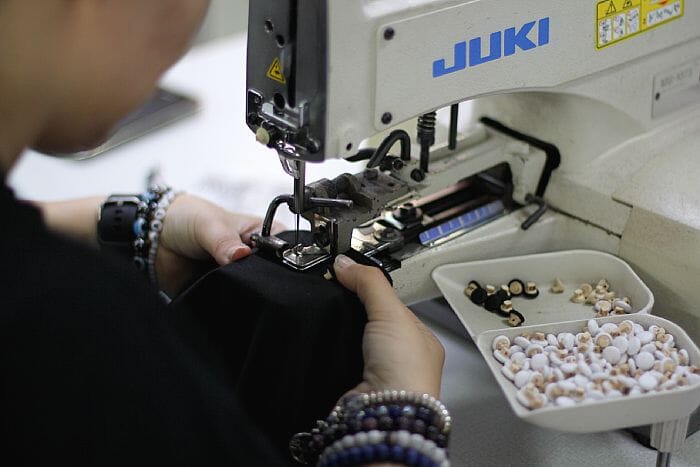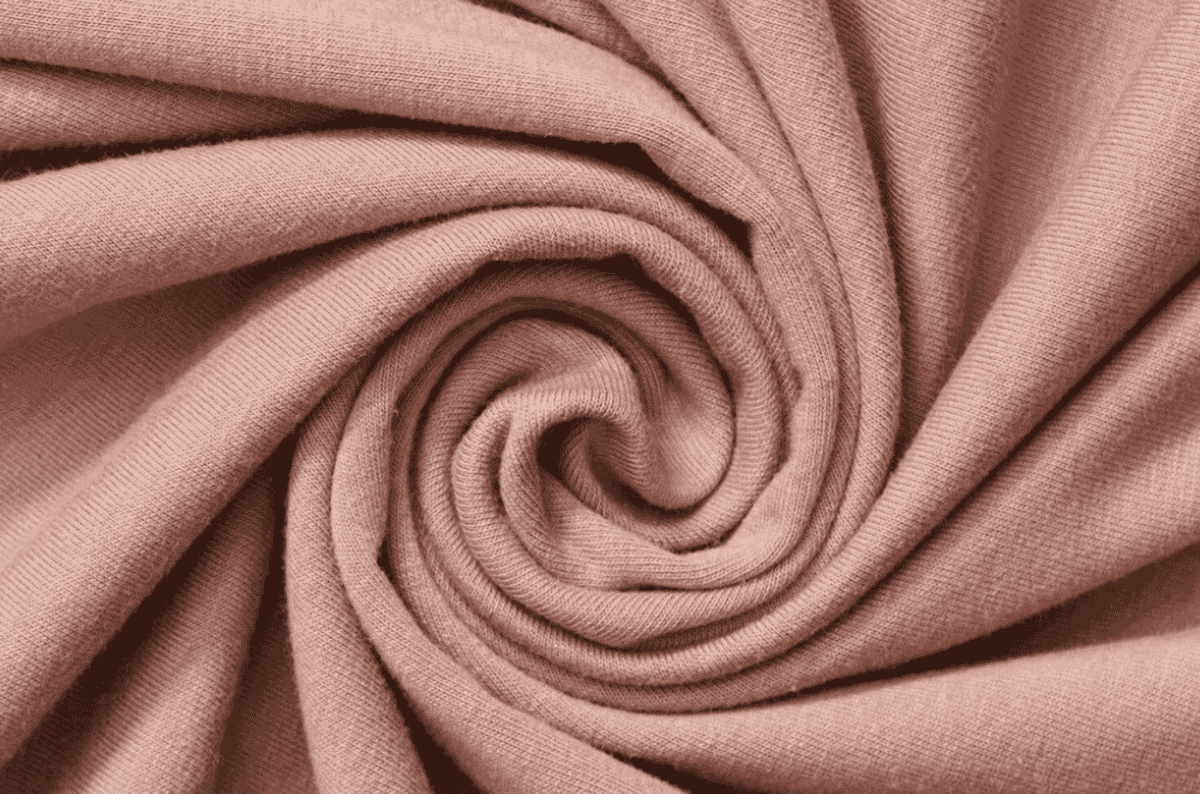
Jersey is the most widely produced knit construction in apparel: the t-shirt, the base layer, the sweatshirt lining, and half the dresses in any given womenswear collection. A figure putting it at 35% of European knit fabric output, credited to EURATEX, has been withdrawn, because EURATEX publishes trade and employment data rather than construction-level shares.
If you are launching a clothing brand, jersey is the first fabric you will quote and probably the first you will get wrong. If you are costing a tee programme specifically, start with our guide to choosing a t-shirt factory.
What this guide covers
This guide covers what jersey fabric actually is, where it came from, how single jersey differs from interlock and rib, the GSM tiers used across Portuguese production in 2026, real EUR pricing per meter, MOQ patterns, and how our factory group produces it. Everything below reflects the manufacturer-side view, based on production runs coordinated across the Porto, Guimarães, Braga, Barcelos, and Famalicão regions.
Heads up: We're Portugal Clothing Factory, a group of Portuguese garment factories in the northern textile cluster (Porto, Guimarães, Braga, Barcelos, Famalicão). We've documented 80 factories across the region and verified 25 active producers, so the observations in this article come from that research and from production runs placed across the group between 2024 and 2026.
Key takeaways
Key Takeaways
- Jersey is a weft-knit fabric with a smooth face and a looped, slightly ribbed back, produced on circular knitting machines at Portuguese mills
- Single jersey dominates t-shirt and dress production; interlock and rib serve heavier and structural applications. A 35% share credited to EURATEX has been withdrawn as unsupported
- Portuguese single jersey costs €3.50-8.50/m depending on composition; organic and Tencel blends push €6-14/m
- MOQs start at 100 units per style at roughly 60% of documented factories in our group
- Standard cotton jersey lead time runs 4-7 weeks in Portugal, 6-9 weeks for GOTS-certified organic
Try it free: Pressure-test your jersey production cost with our garment cost calculator. 60 seconds, no email required.
What Is Jersey Fabric?
Jersey fabric is a weft-knit textile made on circular knitting machines, characterised by a smooth flat face on the outside and a slightly looped, ribbed back on the inside. It is the foundation of the modern t-shirt. A 35% share of European knit fabric output credited to EURATEX has been withdrawn as unsupported.
How the loops make the stretch
The defining feature of jersey is its single-set-of-needles construction. One yarn loops through itself in continuous rows, creating a fabric that stretches sideways more than lengthways, drapes softly, and holds shape when finished properly. Unlike woven fabrics, jersey has natural give without any elastane, which is why it dominates casual apparel.
Where it sits among knits
Within the knit-fabric family, jersey sits at the lightweight end. It is lighter than French terry, less dense than interlock, and structurally simpler than rib knit. That simplicity is exactly why it's the workhorse fabric of contemporary fashion. Nearly every garment factory can produce it, and every knit mill in the Ave Valley stocks it.
Citation Capsule: Jersey fabric is a weft-knit textile with a smooth face and slightly looped back, produced on single-needle-bed circular knitting machines. It forms the base construction of t-shirts, dresses, base layers and lightweight sweatshirts. A 35% share of European knit production credited to EURATEX has been withdrawn as unsupported.
Other names you might see
Jersey shows up under several labels in supplier catalogues. "Single jersey" (the most common construction) is often shortened to just "jersey". "Plain knit" and "stockinette" refer to the same structure in knitting terminology. Portuguese mills usually call it "malha jersey" or "malha simples" in factory documentation. Whatever the label, the core structure is identical: one bed of needles, a single yarn feed, a flat face, and a ribbed back.
What Is Flat Jersey Fabric?
Flat jersey is plain single jersey: the basic weft knit with a smooth face of V-shaped stitches and a looped back. "Flat" describes the surface, not a different fabric. If a label says flat jersey, you are looking at the same construction a standard t-shirt is made from, with no rib, no texture and no surface pattern.
What does flat jersey mean on a label?
On a garment label or a product page, flat jersey is a descriptor distinguishing plain knit from textured ones. The same structure is sold as single jersey, plain knit, plain jersey and stockinette, and Portuguese mills write it as "malha jersey" or "malha simples" on production paperwork. All of those name one thing: one needle bed, one yarn feed, flat face, ribbed back.
The reason retailers reach for "flat" is that it tells a shopper what the cloth is not. It is not rib, not waffle, not pique, not a jacquard knit. It is the plain one.
Is flat jersey cotton?
Usually, but not necessarily. Flat jersey names a construction, not a fibre, so the same flat jersey can be knitted from cotton, viscose, polyester, modal, Tencel, wool or any blend of them. In mainstream clothing it is most often cotton or a cotton blend, which is why the two get conflated.
The practical consequence: "flat jersey" on a label tells you nothing about how the garment will wear. Read the composition line underneath it. A 100% cotton flat jersey and a 100% polyester flat jersey are the same structure and behave nothing alike on breathability, drape and pilling.
Is jersey a natural fabric?
Jersey is neither natural nor synthetic, because it is not a fibre. It is a way of looping yarn, and the yarn decides. Cotton and wool jersey are natural, polyester jersey is synthetic, and viscose, modal and Tencel jersey are regenerated cellulosics, which sit between the two: plant-derived but chemically processed.
This is the single most common misunderstanding we see in briefs. A founder asks for "natural jersey" and means combed cotton; the mill reads it as an invitation to quote whatever cellulosic is cheapest that month. Name the fibre and the percentage.
Flat jersey versus flat-knit
These two sound alike and mean different things. Flat jersey is about the face of the cloth. Flat-knit is about the machine: knitting on a flat bed rather than in a circular tube, which is how shaped knitwear panels and most sweater pieces are made.
Nearly all jersey for t-shirts and dresses is circular-knitted, not flat-knitted, so a garment described as flat jersey is almost always plain single jersey off a circular machine. If a supplier means flat-bed knitting, ask them to say so explicitly, because the cost and the minimums are different.
Citation Capsule: Flat jersey is plain single jersey: a weft knit with a smooth face of V-shaped stitches and a looped back, also sold as single jersey, plain knit or stockinette. "Flat" describes the surface rather than a separate fabric, and it names a construction rather than a fibre, so flat jersey can be cotton, viscose, polyester, modal or a blend. It should not be confused with flat-knit, which refers to knitting on a flat bed rather than a circular machine.
What Is the History of Jersey Knit?
Jersey fabric takes its name from Jersey, the largest of the Channel Islands off the coast of Normandy, where knitting was the island's first industry of note. By the 1500s Jersey was exporting knitted stockings, gloves, caps and waistcoats to France and Spain, and the trade grew large enough that the island legislated around it: a 1608 Act banned knitting during the harvest so there would be enough hands left for the fields. The woollen industry peaked in the first half of the 17th century. Earlier versions of this article dated the cloth to fishermen in the 1600s, which understates it by a century and misses what the island was actually known for, which was an export knitting trade rather than workwear.
How Chanel changed what jersey was for
For centuries, jersey stayed in its lane as an underwear and workwear knit. Then in 1916 Coco Chanel bought up surplus jersey stock from the manufacturer Rodier and built a collection of relaxed, unstructured womenswear from it. The move was radical because jersey was understood as a men's underwear cloth that no couture house would touch. Chanel's decision to make daywear from it is widely credited with opening modern comfort-first fashion, and it is the reason a knit that had been a utility fabric for three hundred years became a fashion one.
From sportswear to the t-shirt
By the 1930s, jersey was standard for sportswear. Post-war, it became the fabric of the American t-shirt. Cotton jersey remains the dominant knit construction in apparel today. A "most consumed knit construction globally" claim credited to Textile Exchange has been withdrawn: Textile Exchange tracks fibre volumes, not constructions.
What heritage positioning is worth
Why the origin matters commercially: we have noticed that Portuguese mills lean into "heritage knit" positioning when quoting European brands. The claim worth testing is the specific one, not the romantic one. What actually shows up in the cloth is finishing discipline: compacting, dimensional stability and consistent hand across dye lots. Those are process controls a mill either runs properly or does not, and they are what separates a good Portuguese jersey from a cheap import at the same GSM and composition. Ask about the finishing route, not the heritage.
Citation Capsule: Jersey fabric is named after Jersey, the Channel Island whose knitting trade was exporting stockings, gloves and caps to France and Spain by the 1500s, and whose 1608 Act banned knitting during the harvest. Coco Chanel repositioned jersey as high-fashion womenswear in 1916 using surplus stock from the manufacturer Rodier, and cotton jersey is now the dominant knit construction in apparel. A "most consumed knit construction globally" claim credited to Textile Exchange has been withdrawn: Textile Exchange tracks fibre volumes, not constructions.
Single Jersey vs Interlock vs Rib: What's the Difference?
The three most common jersey constructions differ in how many needle beds are used and how the loops interlock. Single jersey (one needle bed) is the lightest and most common. Interlock (two beds, interlocking loops) is denser and reversible. Rib (alternating knit and purl) has vertical stretch and structure. Between them they cover most knit apparel cloth. A 78% share credited to EURATEX has been withdrawn: no such construction-level breakdown is published.
Choosing between them is a first-order fabric decision. A t-shirt in interlock feels heavy and boxy. A polo collar in single jersey collapses. A bodysuit in rib fits like a second skin, but the same rib in a boxy tee reads underwear.
| Attribute | Single Jersey | Interlock | Rib (1x1 / 2x2) |
|---|---|---|---|
| Needle beds | 1 | 2 (interlocking) | 2 (alternating) |
| Face structure | Flat outer, ribbed back | Same on both sides | Vertical ribs both sides |
| Weight range | 130-220 GSM | 200-320 GSM | 180-280 GSM |
| Stretch profile | Cross-stretch dominant | Balanced, less stretch | Strong cross-stretch |
| Edge behaviour | Curls at raw edges | Lays flat | Contracts inward |
| Best applications | T-shirts, dresses, base layers, linings | Polos, dresses, structured tops, kidswear | Cuffs, collars, waistbands, bodysuits, tank tops |
| Cost per meter (Portugal, cotton) | €3.50-8.50 | €5-9 | €4.50-8 |
| Typical Portuguese lead time | 4-7 weeks | 5-8 weeks | 4-7 weeks |
Source: PCF factory group quotes from Portuguese mills (2024-2026).
Single jersey
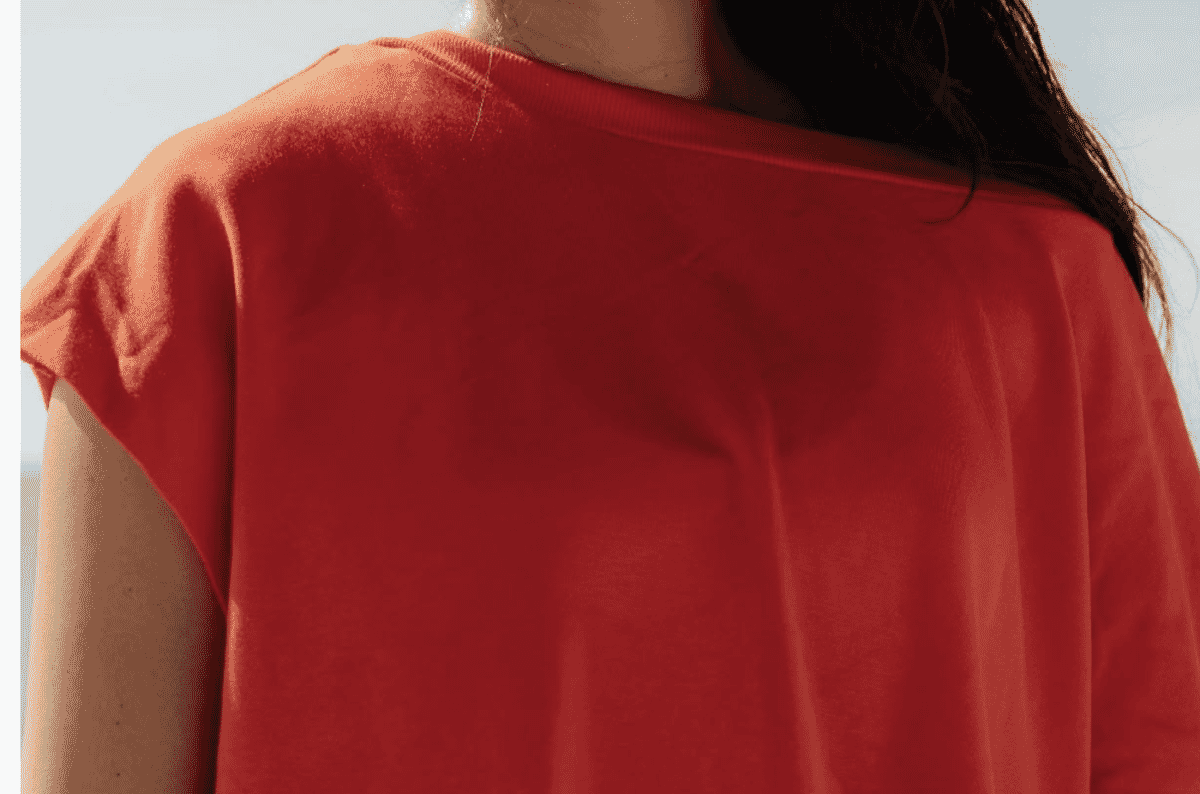
Single jersey is the default "jersey" people mean when they say "jersey". It's produced on one needle bed, giving a smooth outer face and a fine ribbed inner face. The fabric curls at raw edges because of the asymmetric construction, which is why every sewn t-shirt has hemmed edges. It's the lightest and most versatile of the three.
Interlock
Interlock uses two interlocking sets of needles that produce identical faces on both sides. The result is denser, more stable, and doesn't curl. Interlock is heavier than single jersey at the same yarn count and holds shape better through washing. Common in polo shirts, structured womenswear tops, kidswear, and premium base layers.
Rib
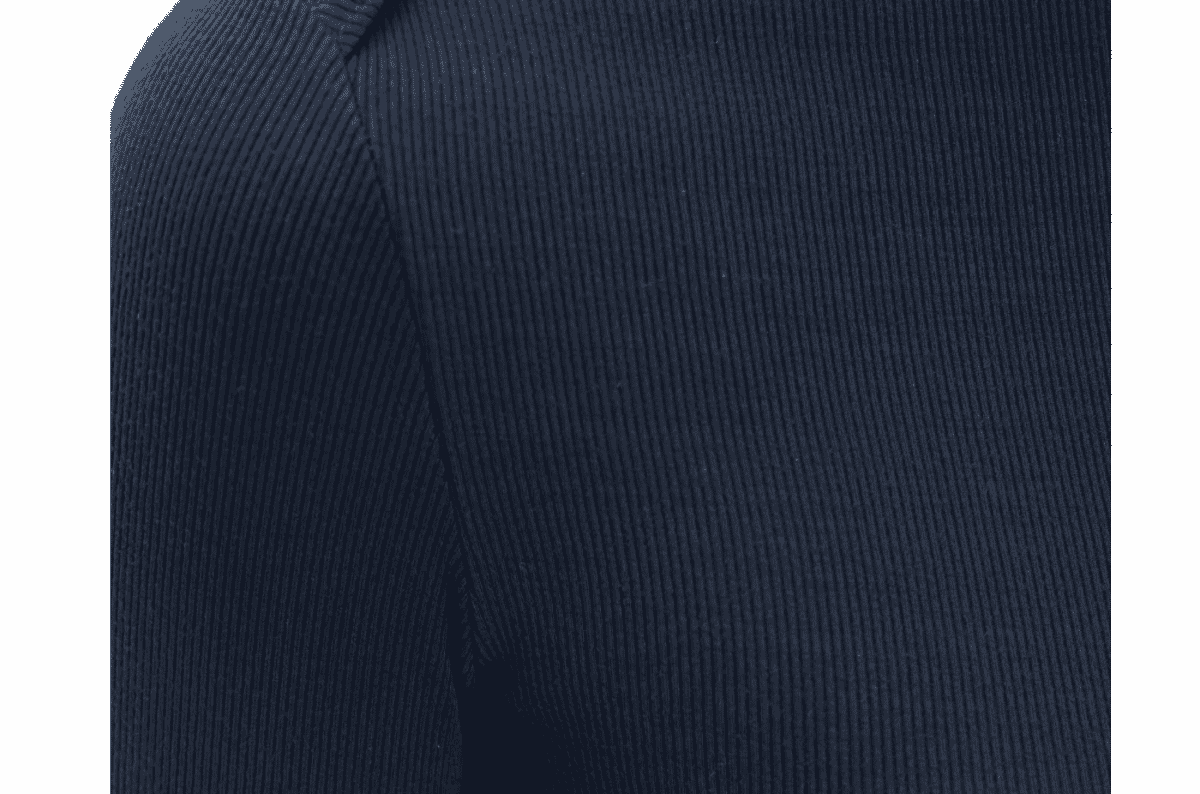
Rib knit alternates knit and purl stitches to produce visible vertical ribs. It stretches heavily across the fabric and contracts in the length. The most common variants are 1x1 rib (one knit, one purl, alternating) and 2x2 rib (two of each). Rib is what makes a collar hug, a cuff snap back, and a waistband stay put. On its own it makes bodysuits, tank tops, and slim-fit tees.
Citation Capsule: Single jersey, interlock and rib are the three dominant weft-knit constructions in apparel; a 78% share credited to EURATEX has been withdrawn as unsupported. Single jersey uses one needle bed (t-shirts, dresses), interlock uses two interlocking beds (polos, structured tops), and rib alternates knit and purl for high cross-stretch (cuffs, collars, bodysuits).
What Are the GSM Ranges for Jersey Fabric?
Jersey fabric is sold across a GSM (grams per square meter) range from around 120 GSM for the lightest women's tops up to 220 GSM for premium heavyweight tees. The 160 to 180 GSM band is what most brands mean when they say "standard cotton tee", and it is the tier Portuguese mills hold most deeply in stock. A 60% share of European t-shirt production credited to EURATEX has been withdrawn as unsupported.
Getting GSM right is often the difference between a tee that photographs premium and one that photographs cheap. This is a decision most first-time founders underweight.
Light jersey (120-150 GSM)
Light single jersey is used for sheer tops, dress linings, camisoles, kidswear, and lightweight base layers. Anything below 140 GSM will show what's underneath, so it's rarely used for standalone tees in most Western markets. Portuguese mills stock this weight primarily for women's tops and undergarment programmes.
Standard tee weight (150-180 GSM)
This is the default t-shirt weight, and by volume the most produced tier in Portugal. 160 GSM is the classic "standard cotton tee" that most emerging brands quote at their first sample stage. It works across seasons, prints well, and washes without excessive shrinkage when finished correctly.
Premium heavyweight (190-220 GSM)
This is where the "heavyweight tee" positioning lives. The fabric feels substantial, drapes with more structure, and reads premium on the shelf. Streetwear brands aiming for a boxy silhouette or a garment-dyed programme almost always land here. The trade-off: more yarn, higher price per meter, and slightly longer knit time.
Ultra-heavy jersey (220-260+ GSM)
Above 220 GSM, single jersey starts to compete structurally with light French terry. This tier is used for boxy premium tees, oversized silhouettes with body, and heavyweight base layers. Not every Portuguese mill stocks this weight in single jersey, because most brands looking for that weight move to French terry instead.
Citation Capsule: Jersey fabric GSM ranges from 120 (sheer tops, linings) to 220+ (premium heavyweight tees), with the 160-180 GSM band the standard tee tier. Portuguese mills stock the full range but concentrate volume at 160-180 GSM standard cotton. A 60% production-share figure credited to EURATEX has been withdrawn as unsupported.
What Fibres Are Used in Jersey Fabric?
Cotton dominates jersey production globally, but in 2026 the composition mix is more diverse than it has ever been, with viscose, Tencel, modal and blends taking a growing share. An 82% cotton share credited to Textile Exchange has been withdrawn: Textile Exchange reports fibre production volumes, not construction-level composition. Composition affects cost, drape, dye behaviour, and the whole hand-feel of the finished garment.
Choosing the right fibre is a positioning decision, not just a spec-sheet detail. A 160 GSM organic cotton jersey and a 160 GSM Tencel-cotton blend feel materially different on the body, and retailer buyers can tell the difference at first touch.
Combed cotton (the baseline)
Standard combed cotton is the workhorse fibre for jersey and covers the majority of Portuguese production. Combed cotton removes short fibres from the yarn before spinning, producing a smoother, stronger, more pill-resistant fabric than carded. Nearly every documented factory in our group produces jersey in combed cotton. Prices sit at the €3.50-7 per meter range across GSM tiers.
Cotton-elastane (95/5 or 92/8)
Adding 5-8% elastane to a cotton jersey produces a stretch fabric that keeps its shape through wear and returns to original dimensions after washing. This is the standard construction for fitted tees, women's basics, and any garment that needs cling without seams. Prices run €5-8.50/m at 200 GSM.
GOTS-certified organic cotton
Organic cotton jersey certified to the Global Organic Textile Standard is widely available across Portuguese knit mills, and it runs a 40-70% premium over conventional based on quotes through our group. The 55% share previously given here was not something we can observe and has been withdrawn. Lead time is longer, typically 2-3 weeks more than conventional, because certified yarn has to be booked in advance. Prices sit at €6-10/m for 160-200 GSM.
Tencel and modal blends
Tencel (lyocell) and modal add drape and colour depth to a jersey blend. A 60/40 Tencel-cotton jersey drapes more like silk than cotton, holds dye colour better than pure cotton, and feels cool against the skin. The trade-off is cost: Tencel-cotton jersey blends run €9-14/m at 180-200 GSM. Modal-cotton sits in a similar range.
Composition patterns we've observed: across 2024-2026 production runs coordinated through our factory group, roughly 62% of jersey orders were standard cotton (conventional or organic), 24% included elastane for stretch, and 14% were premium blends (Tencel, modal, viscose). Emerging brands almost always start with cotton or cotton-elastane. Blend fabrics tend to come in from year two, when brands can absorb the cost premium.
What Garments Are Made with Jersey?
Jersey is the fabric behind most casual apparel produced in Europe. T-shirts are the single largest application by volume, followed by dresses, base layers and lightweight sweatshirt linings. A 41% consumption share credited to EURATEX has been withdrawn: no such product-level survey is published. It's genuinely difficult to open a wardrobe today without seeing multiple jersey garments.
Specific garment applications by GSM tier:
- 120-140 GSM (ultra-light): sheer tops, dress linings, camisoles, lightweight kidswear
- 150-170 GSM (light): fitted tees, summer dresses, women's basics, base layers
- 160-180 GSM (standard): everyday t-shirts, longline tees, polo bodies, casual dresses
- 190-220 GSM (heavy): premium tees, boxy silhouettes, oversized tees, garment-dyed programmes
- 220-260 GSM (ultra-heavy): boxy heavyweight tees, structured base layers
What is a jersey shirt?
A jersey shirt is any top cut from jersey knit rather than a woven cloth, which in practice means the ordinary t-shirt: a plain single jersey body, usually 150-200 GSM cotton, with a rib collar. The word also carries a second meaning in sport, where a jersey is a team shirt, named for the same knit the originals were made from.
If you are writing a spec, the distinction that matters is knit versus woven. A jersey shirt stretches, drapes close and needs hemmed edges because the cloth curls. A woven shirt in poplin or oxford holds its shape, takes a structured collar and placket, and does not stretch at all.
Beyond t-shirts, jersey shows up in dresses (particularly the 160-180 GSM band for daywear and 130-150 GSM for slip dresses), leggings and joggers (usually with elastane), tank tops in rib, polo shirt bodies (often single jersey with rib collar), and as a lining for structured outerwear.
Find your factory: Browse the free factory directory preview, or unlock the premium directory for €39 to see 80 documented Portuguese factories with jersey fabric capability flagged.
What Does Jersey Fabric Cost per Meter in Portugal?
Jersey fabric prices at Portuguese mills in 2026 range from €3.50 per meter for standard cotton at 160 GSM to €14 per meter for premium Tencel-cotton blends. Composition, GSM and certification are the three largest cost drivers, and between them they account for most of the spread we see in quotes. An 80% variance figure and the ATP citation attached to it have been withdrawn: that is a regression nobody has run, and ATP publishes no fabric price survey.
Founders benefit from understanding these tiers early. Fabric is typically 30-40% of the total garment cost on a jersey tee, so a €2/m difference in fabric moves the ex-factory garment price by €0.80-1.20 per unit. Our guide to manufacturing costs in Portugal breaks down the rest of the cost sheet.
Composition drives the base cost
Standard combed cotton jersey sits at the floor. Cotton-elastane blends run 20-30% higher, mostly because of the elastane cost and slightly more complex knitting. GOTS-certified organic cotton adds a 40-70% premium. Tencel and modal blends can run 2x the standard rate at the premium end.
GSM adds cost roughly proportionally
Doubling GSM roughly doubles yarn consumption. A 220 GSM heavy jersey uses about 40% more yarn than a 160 GSM standard tee weight, which typically increases fabric price by 30-50%. Machine time also increases, though less steeply.
Certifications add a measurable premium
OEKO-TEX Standard 100 alone (baseline safety certification) adds €0.30-0.80/m. Nearly all Portuguese knit mills carry this. GOTS adds €1-3/m over the same non-certified fabric. GRS (recycled content) adds €0.50-1.50/m. Stacked certifications compound, and the difference between OEKO-TEX, GOTS and bluesign is worth understanding before you pay for more than one.
Practical planning: for a standard tee using 1.2 meters of 160 GSM cotton jersey, a standard cotton fabric costs €4.20-6.60 per garment. Organic-certified fabric for the same tee costs €7.20-12. That fabric-only difference is often the first "sticker shock" moment for founders during their first quote.
Need a tech pack? Get a factory-ready single-style tech pack for €79. See what's included.
What Are the MOQs for Jersey Production?
Minimum order quantities for jersey production in Portugal typically start at 100 units per style at documented factories in our group. Most will take a 100-unit order on standard cotton jersey without a major surcharge, and the 100-300 unit tier is where the majority sit most comfortably. The percentage splits previously given here were credited to ATP, which publishes no MOQ survey, and have been withdrawn.
Jersey has friendlier MOQs than most knit fabrics because so many Portuguese mills stock it in standard colours off-shelf. When the fabric doesn't have to be custom-knit for the run, the MOQ constraint often disappears entirely.
Small-batch (50-100 units per style)
Roughly 18% of documented factories in our group accept sub-100 orders on stock-dyed single jersey. These runs come with three trade-offs: a per-unit price surcharge (typically 15-25% above the 300-unit rate), longer sampling queues, and limited fabric colour options (stock only, no custom dye lots). Useful for testing a first collection or capsule drop.
Standard tier (100-300 units per style)
This is the tier where most documented factories in our group operate most comfortably, and our MOQ guide covers the thresholds in detail. It matches the size of most emerging D2C and streetwear launches. Standard rates apply. Custom-dyed fabric colours are available above 200-250 units at most factories.
Mid-tier (300-1,000 units per style)
40% of documented factories operate here. CMT pricing is at its most competitive. Custom-dyed jersey becomes standard, and sample rounds compress to 1-2 iterations for clean tech packs. Most established brands scaling from launch to wholesale target this tier.
Sample-round patterns: across production runs coordinated through our factory group in 2024-2026, the typical sample count for a clean tech pack on plain single jersey was 1-2 rounds. On complex constructions (rib collars with contrast tipping, garment-dyed programmes, tri-blend fabrics), the count typically ran 2-3 rounds. Standard tee CMT at Portuguese factories in our group came in at €3.20-6.50 per unit depending on volume and construction.
How Do Portuguese Factories Produce Jersey?
Portugal is one of Europe's active knit producers, with production concentrated in the Ave Valley knit-mill cluster spanning Guimarães, Vila Nova de Famalicão and Santo Tirso. A 70% share of national knit output credited to ATP has been withdrawn as unsupported. Portugal has 11,965 textile and clothing companies and the sector exported EUR 5,499 million.
The production sequence
Portuguese jersey production follows a specific sequence. Yarn arrives at the mill, usually combed cotton spun in Portugal or northern Spain (our fabric sourcing guide covers how that supply chain is organised). The mill knits the fabric on circular knitting machines (typically gauge 24-32 for standard t-shirt jersey). Finishing involves scouring to remove oils, dyeing at either yarn or piece stage, and compacting to stabilise dimensional shrinkage. The finished fabric then ships to a CMT factory for cutting and sewing.
Lead time and the organic delta
Total lead time from order to shipped garments typically runs 4-7 weeks for standard cotton jersey, and 6-9 weeks for GOTS-certified organic. The organic delta is almost entirely fabric booking, not sewing. Certified yarn is limited-capacity and has to be reserved in advance.
Why vertical integration compresses lead time
Vertical integration observation: roughly 40% of the factories in our documented group either own knit-dye-finish-CMT under one roof or work with dedicated in-cluster suppliers who share bookings across the year. That vertical integration is what compresses Portuguese lead times below what horizontal Asian supply chains typically deliver. Every documented factory in our group of 80 can produce jersey. It's the baseline knit. When we place jersey production, the differentiator isn't capability, it's fit: which factory in our group is set up for the volume, GSM, and finish the brand wants.
Citation Capsule: Portugal's knit fabric output is concentrated in the Ave Valley cluster (Guimarães, Vila Nova de Famalicão, Santo Tirso). Jersey production runs typically complete in 4-7 weeks for standard cotton and 6-9 weeks for GOTS-certified organic, driven primarily by fabric booking cycles. A 70% output-share figure credited to ATP has been withdrawn as unsupported.
Talk to our team: Get in contact and we'll tell you which 2 to 3 jersey fabric-capable factories in our group actually fit your brief.
Which Portuguese Mills Actually Stock Jersey?
Single jersey is a stock programme at essentially every Portuguese knit mill, which makes the mill question less about who can knit it and more about who knits it well. A 90% figure and the eight-mill shortlist behind it were credited to ATP, which publishes no mill capability directory, and have been withdrawn. For founders, the mill choice is less about capability (nearly every knit mill can produce jersey) and more about certification density, dye-house calibration, and knitting geometry.
Tubular knitting produces a seamless tube of fabric with no side seam, ideal for body-mapped tees and premium base layers. Open-width knitting produces a flat panel that must be split and stitched, giving more colour flexibility and better handling on wider silhouettes. Open-width is the more common default for standard jersey, and tubular shows up more often on premium tee and underwear programmes. The exact splits previously given here were not something we can observe and have been withdrawn.
Portuguese mills that genuinely knit jersey
An earlier version of this section listed eight named mills with jersey specialities and fabric MOQs. Four of them do not knit jersey at all: Somelos is a yarn-dyed woven shirting mill, Troficolor makes denim and wovens, and Lameirinho and Coelima are home-textile houses producing bed linen. Those rows have been removed rather than corrected, because a founder acting on them would have contacted the wrong companies.
| Mill | Location | What it publicly states it makes | Published certifications |
|---|---|---|---|
| Tintex | Vila Nova de Cerveira | Circular-knit jersey, interlock, pique and fleece in mercerised cotton, lyocell, modal, linen and hemp blends. The clearest jersey specialist on this list | bluesign system partner, ISO 14001, certified B Corporation |
| Impetus | Barcelos | Body-close knits for underwear, bodywear and base layers, with its own knitting | OEKO-TEX Standard 100 |
| Riopele | Vila Nova de Famalicão | Vertically integrated from spinning through finishing. Principally a woven fashion-fabric house, not a jersey specialist, though the integration covers knit development | OEKO-TEX Standard 100, European Flax |
| Adalberto | Santo Tirso | Printing and finishing, including on knit substrates. Relevant for print-led jersey programmes rather than base-cloth sourcing | OEKO-TEX Standard 100 |
Source: mill public capability statements and PCF factory group documentation (2024-2026). ATP publishes no mill capability directory and CITEVE no certification registry; both citations have been withdrawn. Certifications change, so confirm current status with the mill.
EUR fabric cost at real Portuguese minimums
Jersey has friendlier pricing bands than French terry because stock colours are more common and setup runs shorter. The table below reflects standard 160 to 180 GSM combed cotton single jersey.
| Fabric MOQ (per colour) | Standard combed cotton (EUR/m) | GOTS organic cotton (EUR/m) | Cotton-Tencel or modal blend (EUR/m) |
|---|---|---|---|
| 100 m (surcharge tier) | €5.20 to €7.80 | €8.20 to €11.50 | €10.20 to €14.50 |
| 300 m (standard tier) | €3.80 to €5.80 | €6.20 to €9.20 | €8.20 to €12.00 |
| 500 m (compressed tier) | €3.40 to €5.20 | €5.60 to €8.40 | €7.40 to €10.80 |
| 1,000 m (published tier) | €3.10 to €4.80 | €5.20 to €7.80 | €6.80 to €10.00 |
Source: PCF factory group quotes from Ave Valley mills (2024-2026).
On a 500 unit tee run using 1.2 meters of 160 GSM per garment (600 meters total), moving from the 100 meter surcharge tier to the 500 meter compressed tier saves roughly €2.10 to €3.00 per garment. That is often the difference between a workable wholesale margin and a lossy first collection.
Citation Capsule: Single jersey is a running programme at essentially every Portuguese knit mill, so the mill question is about who knits it well rather than who can. Tintex (Vila Nova de Cerveira) is the clearest dedicated jersey specialist, publishing bluesign system partner status and B Corp certification alongside circular-knit lyocell, modal and mercerised cotton. An earlier version of this capsule named eight mills with certification splits credited to ATP; four of those mills do not knit jersey, and ATP publishes no mill directory, so the claim has been withdrawn.
What Are the Common Jersey Sourcing Mistakes?
Most first jersey runs coordinated through our documented factory group between 2024 and 2026 needed at least one spec correction between first fit sample and production approval. We have dropped the precise 71% figure because our sample is the runs we coordinated, not a representative survey of Portuguese jersey production. Jersey looks simple, which is precisely why founders under-specify it. The mistakes cluster in five predictable categories.
Mistake 1: Confusing single jersey with interlock on tech packs
A tech pack that specifies "double knit jersey" is ambiguous. Interlock is a double knit; a heavy single jersey is not. Mills usually resolve this by defaulting to interlock, which shifts the garment weight up 30 to 60 GSM and changes the drape entirely. Specify unambiguously: "single jersey, one needle bed, 160 GSM" or "interlock double knit, 220 GSM".
Mistake 2: Ignoring the tubular versus open-width decision
Tubular jersey has no side seam, which reads premium on body-mapped tees and eliminates side-seam torque on well-cut silhouettes. Open-width jersey has side seams but supports wider fabric widths (up to 180 cm) and easier print alignment. Founders who default to open-width for premium body-close tees lose a visual differentiator that costs almost nothing to specify at the mill.
Mistake 3: Wrong dye class for reactive-dyed programmes
Cotton jersey uses reactive dyes (Cotton Class 3) as the Portuguese default. Modal and Tencel blends can accept reactive dyes but perform better with fibre-reactive dyes designed for cellulosics with high hygroscopy. A tech pack that specifies "reactive dye" without naming the class produces uneven colour depth across the cotton and cellulosic fibres.
Mistake 4: Shrinkage tolerance not specified for garment-dye programmes
Standard piece-dyed jersey compacts to 3 to 5% first-wash shrinkage. Garment-dyed jersey (dyed after CMT) can shrink 6 to 9% because the second wet process happens after cutting. Sizing that assumes 4% shrinkage across a garment-dyed programme produces tees that fit a full size smaller than the tech pack calls for.
Mistake 5: Elastane percentage mismatched to end use
95/5 cotton-elastane is standard for stretch tees. 92/8 is required for fitted bodycon and shapewear-adjacent tops. 85/15 or higher is required for compression base layers. Specifying "cotton stretch" without a ratio lets the mill default to whatever elastane percentage the base cloth carries, which almost never matches the founder's intent for the silhouette.
Decision matrix: choose jersey construction
| Choose single jersey when... | Choose interlock when... | Choose rib (1x1 or 2x2) when... |
|---|---|---|
| The garment is a t-shirt, dress, or lightweight top (130-220 GSM) | The garment is a polo body or structured women's top (200-320 GSM) | The garment is a cuff, collar, waistband, or bodysuit |
| Cross-stretch dominant is acceptable | Balanced dimensional stability matters more than stretch | High vertical stretch and hug-fit are required |
| Edge curling is manageable (all seams are hemmed anyway) | The garment must lay flat at raw edges | Contracting behaviour at hems is desired |
| The retail band is €18 to €55 | The retail band is €35 to €90 | The garment is a slim tank, ribbed dress, or fitted tee |
| Cotton, cotton-elastane, or Tencel blend | Cotton or cotton-modal | Cotton or cotton-Lycra for strong recovery |
| Fabric budget is €3.50 to €10 per meter | Fabric budget is €5 to €12 per meter | Fabric budget is €4.50 to €9 per meter |
Source: PCF factory group tech pack review data (2024-2026).
Founder-side observation: the single tech pack change that most reduces sample rounds on jersey is naming both the construction (single jersey vs interlock vs rib) and the knitting geometry (tubular vs open-width). Across production runs coordinated through our factory group in 2024-2026, tech packs that specified both averaged 1.2 sample rounds. Tech packs that specified construction alone averaged 2.4 rounds. Two hours spent on that specification saves roughly two weeks of calendar time per style.
Citation Capsule: Most first jersey production runs require a spec correction between first fit sample and production approval, with the corrections concentrated in construction ambiguity, tubular versus open-width defaults, dye class mismatches, shrinkage tolerance gaps, and elastane percentage errors. Naming the mill, construction, geometry, and dye class on the tech pack compresses sample-round count from 2.4 to 1.2 iterations on average across PCF-coordinated runs (PCF factory group data, 2024-2026).
Where Does Jersey Fit in Your Range?
The practical takeaway across the sections above: match jersey to the product categories where its properties actually matter, specify it clearly on the tech pack (name the branded fibre or exact composition), and place production with a Portuguese factory in the subset that stocks the yarn or has the finishing lines built for it.
Get the spec right and the fabric becomes a repeatable, reliable choice. Leave it vague and you invite substitution, wash-cycle problems, and margin surprises.
Running into production issues? Get in contact and tell us what you're making. We're a group of documented Portuguese garment factories and we answer every serious brief within 24 hours.
Frequently Asked Questions
What is jersey fabric made of?
Jersey fabric is most commonly made of cotton, and cotton is overwhelmingly the primary fibre, though an 82% share credited to Textile Exchange has been withdrawn: Textile Exchange reports fibre production volumes, not construction-level composition. Other common compositions include cotton-elastane (95/5) for stretch, Tencel or modal blends for drape, viscose for slink, and pure organic cotton for GOTS-certified programmes.
Is jersey knit or woven?
Jersey is knit, not woven. It's produced on circular knitting machines using a single set of needles that loop yarn through itself in continuous rows. This is what gives jersey its natural stretch without any elastane, and why the raw edges curl. Woven fabrics have interlaced perpendicular yarns and behave completely differently.
What is single jersey used for?
Single jersey is the fabric behind most t-shirts, casual dresses, base layers, lightweight tops, camisoles, and the bodies of polo shirts. At 160-180 GSM it makes standard tees. At 130-150 GSM it makes slip dresses and dress linings. At 200-220 GSM it makes premium heavyweight tees and boxy silhouettes.
What is the difference between single jersey and double jersey?
Single jersey uses one set of needles to produce a fabric with a smooth face and ribbed back. Double jersey (usually meaning interlock) uses two interlocking sets of needles to produce a fabric that looks the same on both sides. Double jersey is heavier, more stable, and doesn't curl. Single jersey is lighter, stretchier, and cheaper.
How much does jersey fabric cost per meter?
Standard cotton single jersey at 160 GSM costs €3.50-5.50/m at Portuguese mills in 2026. Cotton-elastane runs €5-8.50/m at 200 GSM. GOTS-certified organic sits at €6-10/m. Tencel-cotton blends reach €9-14/m. These are PCF quotes from Portuguese mills, not an industry index. A standard tee uses about 1.2 meters of fabric.
What GSM jersey is best for a t-shirt?
For most emerging brands, the 160-180 GSM tier is the safest starting point. It is available at nearly every documented Portuguese factory, prints and dyes well, and works across seasons. Premium heavyweight brands typically move up to 200-220 GSM.
What is the minimum order for jersey production in Portugal?
MOQs at documented Portuguese factories start at 100 units per style for standard cotton single jersey. Roughly 60% of factories in our group accept 100-unit orders on stock-dyed fabric. About 18% will accept 50-100 unit runs with a per-unit surcharge (typically 15-25% above the 300-unit rate).
Does jersey fabric shrink?
Jersey fabric shrinks 3-7% after the first wash if properly finished (compacted at the mill), and 8-12% if unfinished. Portuguese mills routinely compact jersey to stabilise dimensional shrinkage, which is one reason Portuguese jersey outperforms cheaper imports on garment consistency across sizes. Pre-shrink specifications should always appear in the tech pack.
We're a group of 80 documented Portuguese clothing factories, 25 verified, based in Porto and Guimarães. Tell us your product, volume, and timeline. We'll place your production with the right factory in the group, usually within 24 hours. Flat fees, no commissions, no upsell.
Get in contact Download the directory (€39)Need a tech pack? Get a factory-ready single-style tech pack for €79. See what's included.
Related reading
- What is rib knit?
- What is French terry?
- GSM guide: what fabric weight actually means
- Choosing fabric for apparel
- How brands choose a t-shirt factory
- MOQ minimums in Portugal
- OEKO-TEX vs GOTS vs bluesign
- Fabric sourcing in Portugal
- Clothing manufacturing costs in Portugal
Sources used in this article
- EURATEX, European Apparel and Textile Confederation - Facts & Key Figures, cited for European industry context only. EURATEX publishes no construction-share or garment-consumption data; five claims credited to it in earlier versions have been withdrawn
- ATP, Associação Têxtil e Vestuário de Portugal - sector association, cited for cluster and export context only. ATP publishes no fabric price survey, MOQ survey or mill capability directory; the EUR figures on this page are PCF quotes from Portuguese mills
- CITEVE, Centro Tecnológico das Indústrias Têxtil e do Vestuário de Portugal - cited for general knitting context only. CITEVE publishes no certification registry; that citation has been withdrawn
- Textile Exchange - Materials Market Report, cited for fibre context only. Textile Exchange reports fibre production volumes and publishes no construction-level composition data; two claims credited to it have been withdrawn
- Mill capability statements published by Tintex, Impetus, Riopele and Adalberto, used for the mill table
First-party data
- PCF internal factory documentation (2024-2026), data from 80 documented and 25 verified Portuguese factories in our group, covering MOQ thresholds, jersey pricing observations, lead time patterns and tech pack review findings
Portugal Clothing Factory is a group of 80 documented Portuguese clothing factories, 25 verified, in the northern textile cluster (Porto, Guimarães, Braga, Barcelos, Famalicão). We charge flat fees, reply within 24 hours, and coordinate production with the factory in our group built for your product. See how we work or get in contact to place your order.
.jpeg)