Portugal textile industry: statistics and data 2027
The latest official figures on Portugal’s textile and clothing industry, from the GEE Sectoral Report (published October 2024, the most recent edition). 12,222 companies. 128,000 workers. €5.8 billion in exports.
Source: GEE (2024), Sectoral Studies 2030, Textile and Clothing Industry in Portugal, Ministry of Economy, Lisbon, October 2024.
Overview
A strategic industry for the Portuguese economy
Portugal’s textile and clothing industry (ITV) is one of the country’s oldest and most resilient industrial sectors. Concentrated in the Northern Region, particularly the Ave and Cávado subregions, it forms one of Europe’s largest integrated textile clusters. The data below comes from the official GEE Sectoral Report published by the Ministry of Economy in October 2024.
Portugal’s textile and clothing industry records a positive trade balance of €634 million in 2023. The import coverage rate reached 112.2%, confirming Portugal’s status as a net exporter in the sector. Exports totalled €5,815M against imports of €5,181M.
Exports€5,815M
Imports€5,181M
Main export destinations
Spain (23.1%), France (16.3%), Germany (8.7%) and the USA (7.9%) are the largest destinations for Portuguese ITV exports.
Spain23.1%
France16.3%
Germany8.7%
USA7.9%
Bars on a 0–100% scale. Source: GEE (2024), Sectoral Studies 2030, Textile and Clothing Industry in Portugal.
Official GEE indicators
Textile and Clothing Industry: Original Charts and Indicators
Key indicators from the GEE Sectoral Studies 2030 report, published by Portugal’s Ministry of Economy in October 2024. The charts cover business structure, productivity, exports, imports and the international positioning of the Portuguese ITV.
Source: GEE (2024), Sectoral Studies 2030, Textile and Clothing Industry in Portugal, Ministry of Economy, Lisbon, October 2024.
01
12,222 Companies in the ITV
In 2022, the ITV comprised 12,222 companies, mostly in the Fashion and Clothing segment (70%). Essentially composed of SMEs (99.7%): 79.9% microenterprises, 15.5% small, and 4.2% medium-sized. These companies employed 128,089 people and generated a GVA of €2.7 billion.
Micro79.9%
Small15.5%
Medium4.2%
Share of ITV companies by size, 2022Original GEE chart02
Concentrated in the Northern Region
ITV companies are primarily located in the Northern Region, concentrated in the Ave and Cávado subregions. The ITV is one of Portugal’s oldest and most traditional industries, remaining one of the country’s largest business sectors.
Original GEE chart03
70% of Companies in Fashion and Clothing
Over 70% of Portuguese ITV companies are concentrated in the Fashion and Clothing segment, which is also the largest employer (57.8% in 2022). Technical and Industrial Textiles and Home Textiles follow with lower relative importance.
Share of companies70.0%
Share of employment57.8%
Fashion and Clothing segment, 2022Original GEE chart04
Apparent Labour Productivity
Both ITV segments show apparent productivity below other industries: Textiles record a GVA per worker of €28,200 and Clothing €19,600. The trend is positive year-on-year, with growth rates above the national manufacturing average.
Textiles€28,200
Clothing€19,600
GVA per workerOriginal GEE chart05
Technological Intensity of the ITV
ITV companies show a lower degree of technological intensity than the Manufacturing Industry average. Even so, they contribute more GVA than Chemicals and Wood and Cork. Technical Textiles lead technological intensity within the ITV (3.41%).
Original GEE chart06
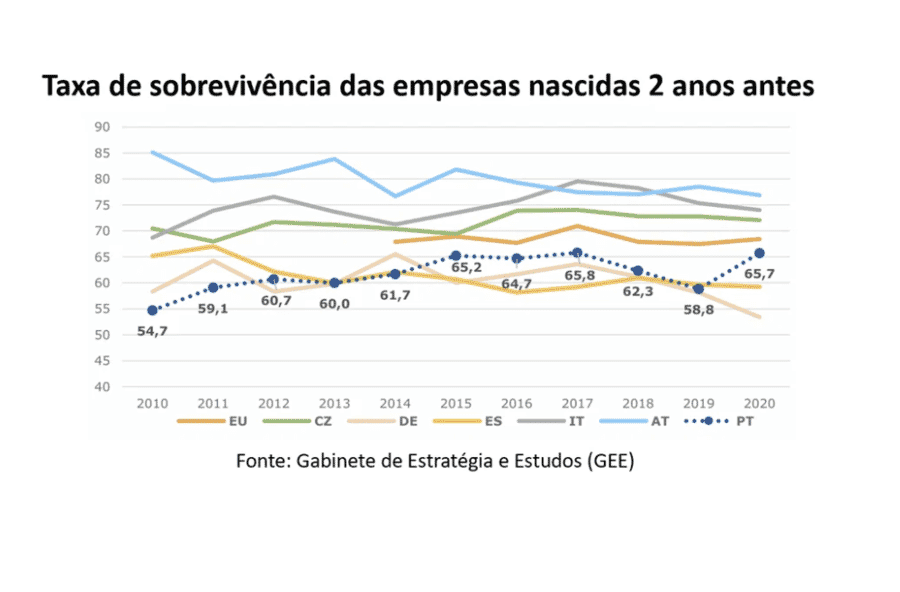
High Company Survival Rate
ITV companies record two-year survival rates of 66% (Textile Manufacturing) and 67% (Clothing Industry), both above the rate for all non-financial companies in Portugal (59%). A clear sign of sector resilience and market stability.
Clothing Industry67%
Textile Manufacturing66%
All non-financial companies59%
Two-year survival rateOriginal GEE chart07
China Leads Global Exports
China leads global ITV exports with a 36.4% share. Vietnam holds 2nd place (5.2%), followed by Germany and Italy. Portugal ranks 27th, with a 0.7% share of world exports. At EU level, it ranks 10th with 3.0% of community exports.
China36.4%
Vietnam5.2%
Portugal (27th)0.7%
Share of world ITV exportsOriginal GEE chart08
€5,815M in Exports (2023)
Portuguese ITV exports reached €5,815M in 2023, representing 7.5% of goods exports. A 5.2% decrease was recorded versus 2022, after a 12.4% increase in 2022. International conflicts and a drop in European demand explain the correction.
€5,815M
exports, 2023
7.5%
of goods exports
−5.2%
vs 2022
+12.4%
in 2022
Original GEE chart09
Fashion and Clothing Dominates Exports
Fashion and Clothing is the dominant segment in ITV exports throughout the period analysed. Fibres, Yarns and Fabrics and Home Textiles follow. In 2023, all segments contributed negatively to the evolution, reflecting global demand contraction.
Original GEE chart10
Spain as Main Export Destination
In 2023, Spain (23.1%), France (16.3%), Germany (8.7%) and the USA (7.9%) were the largest markets for ITV exports. The intra-EU market accounts for 73.1% of the total.
Spain23.1%
France16.3%
Germany8.7%
USA7.9%
Share of ITV exports by destination, 2023Original GEE chart11
€5,181M in Imports (2023)
In 2023, ITV imports were €5,181M, a 5.4% decrease versus the previous year. ITV imports represented 4.9% of total Portuguese goods imports. The Fashion and Clothing segment represented 57.9% of ITV imports.
€5,181M
imports, 2023
−5.4%
vs 2022
4.9%
of goods imports
57.9%
Fashion and Clothing
Original GEE chart12
Spain as Main Import Source
The main source markets for ITV imports are Spain (34.7%), Italy (11.6%) and China (8.8%), representing more than half (55.1%) of the total. The strong Spanish presence reflects Iberian value chain integration in the textile and clothing sector.
Spain34.7%
Italy11.6%
China8.8%
Share of ITV imports by originOriginal GEE chart
All charts: GEE (2024), Sectoral Studies 2030, Textile and Clothing Industry in Portugal, Ministry of Economy, Lisbon, October 2024.
Reply within 24h, factory confirmed within 7 days. One point of contact from sample to delivery.
Directory, €39: you contact them
80+ documented factories with contact emails, minimums where published, specialties, certifications and region. One-time payment, instant access.
Industrial geography
Textile clusters in Portugal: specialisation and scale
Each cluster has a distinct speciality, with different certification profiles, MOQ levels and production capacity. Understanding Portugal’s industrial geography is essential to finding the right factory for the right product.
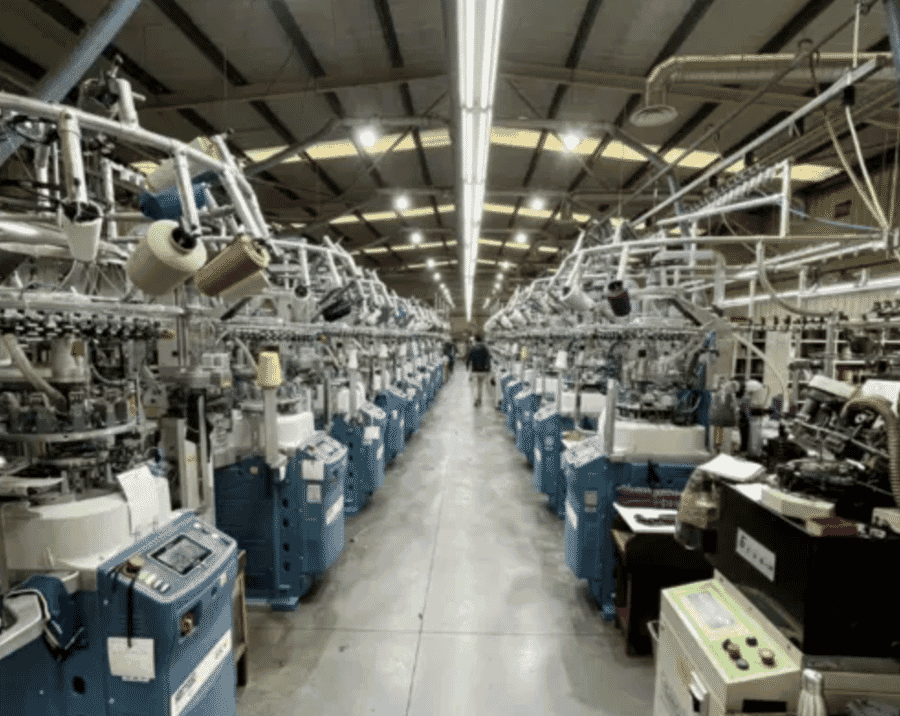
Rib knit
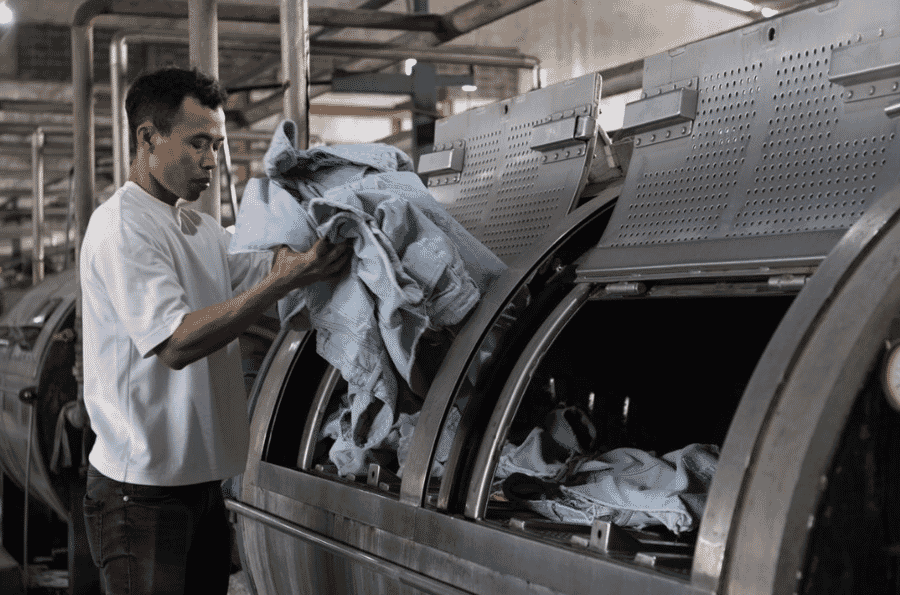
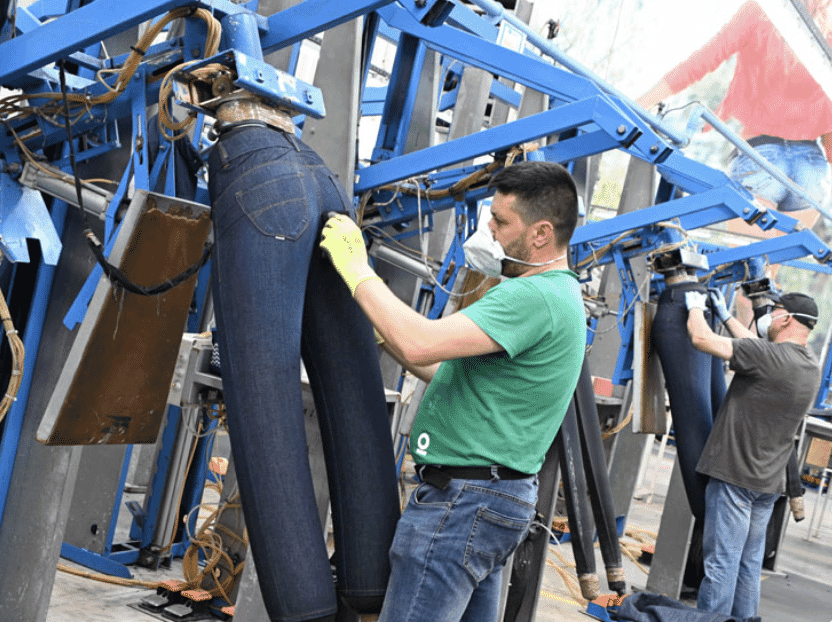
Finishing jeans on forms
Carded wool
Workers per cluster (approx.)
Vale do Ave~45,000
Guimarães~12,000
Braga / Cávado~9,000
Porto / Matosinhos~5,000
Covilhã~3,500
Barcelos~3,000
Bars drawn to scale from the approximate figures in the table below.
Speciality
Common certifications
Typical MOQ
Vale do Ave
Knitwear, jersey, cut and sew
~3,500
~45,000
OEKO-TEXGOTSSA8000
300–1,000 pcs/style
Guimarães
Home textiles, technical fabrics
~800
~12,000
OEKO-TEXISO 9001
500–2,000 m
Braga / Cávado
Outerwear, technical garments
~600
~9,000
bluesignGRSGOTS
200–500 pcs/style
Porto / Matosinhos
Fashion, premium brands, finishing
~400
~5,000
OEKO-TEXSA8000
100–300 pcs/style
Covilhã
Wool, technical textiles, yarns
~150
~3,500
ISO 9001Wool certifications
500+ kg/order
Barcelos
Denim, woven, workwear
~200
~3,000
OEKO-TEXISO 14001
500–1,500 pcs/style
Swipe the table sideways to see certifications and MOQs.
Know your cluster? Send a free brief and we place it with the right factory in it, or use the Factory Directory: 80+ documented factories by region, specialty, MOQ and certification.
Competitiveness, Investment and International Positioning
Additional indicators covering trade balance, comparative advantage, investment, R&D, innovation and productivity trends in the Portuguese textile and clothing industry.
Source: GEE (2024), Sectoral Studies 2030, Textile and Clothing Industry in Portugal, Ministry of Economy, Lisbon, October 2024.
13
Positive Trade Balance: €634M
The trade balance of the Portuguese ITV is positive, reaching €634M in 2023. The import coverage rate was 112.2%, confirming Portugal’s role as a net exporter in the sector. A sustained structural surplus maintained across the full period analysed.
Portugal’s ITV records a Revealed Comparative Advantage (RCA) index of 1.9, above 1.0, indicating the sector is more competitive internationally than the country’s average export profile. This signals genuine, sustained specialisation.
Portugal ITV1.9
Neutral (1.0)1.0
RCA indexOriginal GEE chart15
27th Global Export Ranking
Portugal ranks 27th among the world’s largest textile and clothing exporters, holding a 0.7% share of global exports. In the EU context, it holds 10th place with 3.0% of EU exports. A consistent ranking maintained over the past decade.
27th
global ranking
0.7%
of world exports
Original GEE chart16
10th in EU Textile Exports
Among EU27 member states, Portugal ranks 10th as a textile and clothing exporter with 3.0% of the community total. Germany and Italy lead within Europe. Portugal’s consistent EU ranking reflects decades of industrial specialisation.
10th
EU27 ranking
3.0%
of EU exports
Original GEE chart17
70.2% External Market Weight
The external market accounts for 70.2% of the weight of Portuguese ITV exports, demonstrating strong export orientation. This figure reflects the depth of integration into global fashion supply chains, particularly with European brands.
External market70.2%
Weight of the external marketOriginal GEE chart18
75% of Investment in Fibres and Yarns
Investment in the ITV is heavily concentrated in the Fibres, Yarns and Fabrics segment (75%), reflecting ongoing modernisation of upstream production. The Clothing segment receives a lower capex share despite its larger weight in companies and employment.
Fibres, Yarns and Fabrics75%
Share of ITV investmentOriginal GEE chart19
FDI Growth Rates
Foreign Direct Investment (FDI) in the ITV has shown negative variations in recent years, following broader global contraction in mature textile markets. The sector remains largely domestically funded, with family-owned businesses predominating.
Original GEE chart20
R&D Investment Distribution
R&D investment in the Portuguese ITV is distributed across research centres, universities and companies. The sector benefits from institutional links with technology centres such as CITEVE and university partnerships in the Northern Region.
Within the ITV, Technical and Industrial Textiles record the highest technological intensity (3.41%), reflecting investments in advanced materials, smart textiles and high-performance fabrics. This segment is the main driver of R&D in the sector.
3.41%
technological intensity, Technical Textiles
Original GEE chart22
9.7% Public Support for the ITV
Public support (grants, subsidies, tax incentives) represents 9.7% of ITV investment, above the manufacturing average. EU structural funds, particularly COMPETE and PRR (Recovery and Resilience Plan), are the main sources of public funding for the sector.
Public support9.7%
Share of ITV investmentOriginal GEE chart23
22,376 Trademark Applications
The Portuguese ITV filed 22,376 trademark applications, demonstrating a growing focus on brand building and IP protection. The increasing number of registered brands reflects a structural shift towards higher-margin, design-driven production.
22,376
trademark applications
Original GEE chart24
Positive Productivity Evolution
Labour productivity in the Portuguese ITV has followed a positive trend, with growth rates outpacing the national manufacturing average. This reflects capital investment, automation in spinning and weaving, and improved management practices.
Original GEE chart
All charts: GEE (2024), Sectoral Studies 2030, Textile and Clothing Industry in Portugal, Ministry of Economy, Lisbon, October 2024.
These numbers describe the whole sector. Send a free brief and we place it with the right factory inside it, or get the Factory Directory: the 80+ factories we’ve documented, with MOQs, certifications and contact emails.
As of 2022, Portugal had 12,222 companies in the textile and clothing industry (ITV). Of these, 99.7% are SMEs: 79.9% microenterprises, 15.5% small, and 4.2% medium-sized. Total workforce: 128,089 employees. Source: GEE (2024), Sectoral Studies 2030.
In 2023, Portugal exported €5,815 million in textiles and clothing, representing 7.5% of all goods exports. Spain (23.1%), France (16.3%), Germany (8.7%) and the USA (7.9%) are the main destinations. The sector recorded a positive trade balance of €634 million. Source: GEE (2024).
The vast majority of Portugal’s textile companies are in the Northern Region, particularly the Ave and Cávado subregions. The Ave Valley (Vale do Ave) is the largest cluster, specialising in knitwear, jersey, and cut-and-sew garments. Porto and Braga also host significant manufacturing capacity.
Portugal ranks 27th globally and 10th in the EU for textile and clothing exports. China leads globally with 36.4% of world exports. Portugal holds a 0.7% global market share and a 3.0% EU market share. Source: GEE (2024), Sectoral Studies 2030.
Work with a Portuguese factory
Ready to start production in Portugal?
We review your brief by email and place it with the right factory in the right cluster. No agency fees. No commission on orders.
.jpeg?w=736&format=optimal)
.jpeg?w=735&format=optimal)
.jpeg?w=735&format=optimal)
.jpeg?w=735&format=optimal)


.jpeg?w=900&format=optimal)
.jpeg?w=900&format=optimal)

.jpeg?w=736&format=optimal)